Purpose
To introduce an important update that enhances the accuracy of combination exam identification in DIR CT Exam Name Mapping Tool.
History
The ACR DIR has logic to identify combination exams that are split on CT scanner consoles, such as a CHST-ABD-PEL exam performed with two acquisitions. In these cases, the DIR receives an identical DICOM Radiation Dose Structured Report (RDSR) for each of the resulting “exams” and identifies split exams using a series of matching parameters that are identical in the duplicate RDSRs.
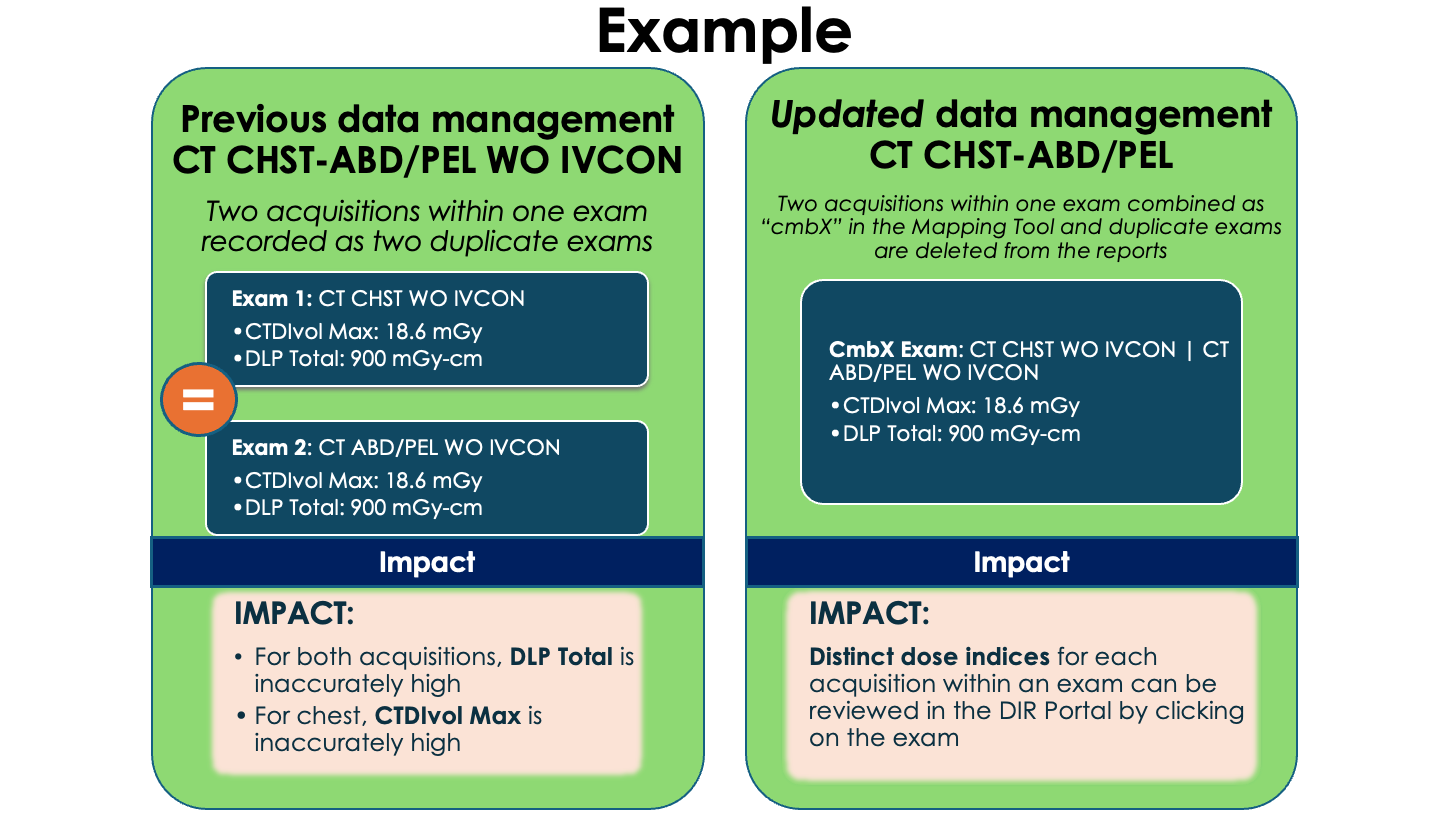
Previously, DIR’s matching parameters included Study Instance UID (SUID). This caused issues when exams were split on the scanner console because some CT systems create new SUIDs when splitting exams. This limitation impacted reporting accuracy, including the CT Executive Summary and Leapfrog reports. With the improved logic, counts for combination exams will be significantly more accurate. An example is described at the end of this article, and an infographic is attached to visualize the change.
What’s New:
Data from 2025, 2024 and 2023 exams has been corrected. Exams for a particular study are now matched based on the parameters (patient age, patient date of birth, patient sex, date and time of exam, station name, CTDIvol and DLP Total), and duplicate exams have been removed so only unique combination records exist.
Combination exams will now be prefixed with “CmbX:” in the Exam Name Mapping Tool, allowing you to map them to the appropriate combination RPID. We realize that sometimes there might not be an RPID for exams with several acquisitions and Study Descriptions; this is a limitation we are working to address.
What to Expect:
You will see changes to dose trends at your institution, these changes reflect improved dose reporting accuracy.
Example: If a patient has a CHST-ABD-PEL CT done in two acquisitions, the exam was split and the two Study Descriptions mapped in DIR to CHST and ABD/PEL, there were two identical exams displaying identical dose data. That is, the CTDIvol Max for both acquisitions was probably in the pelvis but the same CTDIvol Max was displayed in the duplicate CHST exam, the DLP Total was be the sum of both acquisitions in both of the duplicate exams, etc.; with the chest acquisition mapped to "CT CHST WO IVCON" your routine chest exam data would be skewed by the abd/pel acquisitions.